AI that can act.
And knows when not to.
We design AI systems that research, remember, decide, create and operate inside real business workflows, with explicit boundaries around what they can touch and when a person stays in control.
“We are getting traffic but almost nobody books.”
Qualified service enquiry · brand strategy
The system proposes. A person releases the action.
AI is easy to demo.
Reliability is harder.
A clever answer is not the same thing as a dependable system.
The difficult questions begin after the demo.
A trustworthy agent is designed as a chain of constraints.
What it knows
The documents, pages and records the system is allowed to read, and the boundary where that reading stops.
What persists
What is kept between conversations, for how long, and who can see or remove it.
What it can access
Each connected system is a decision: what it may read, what it may write and what stays out of reach entirely.
What it may do
Actions are separated into what runs without asking, what waits for a person, and what is never allowed.
What it changes
Every write is named, logged and reversible where the underlying system allows it.
How success is checked
The system has to be able to tell the difference between having answered and having answered correctly.
When a person takes over
The point where the system stops guessing and hands the decision to someone accountable.
Escalation is not a failure state. It is the part of the design that decides what the system is allowed to be wrong about.
Use it.
The interesting part of an agent is not the reply. It is the state around the reply: what it used, what it was allowed to do, and where a person had to agree.
We are getting traffic but almost nobody books.
Before recommending more acquisition, I would inspect the point where interest becomes commitment. Do people understand the offer, see enough proof and know what happens after they click?
Then tell me what is broken.
I can audit the public pages and show you where confidence breaks. I cannot contact anyone or change your CRM until a person releases that action.
We need a month of content without sounding like everyone else.
I will work from the positioning, the customer objections and what you have already published, so the first draft argues a point rather than filling a calendar.
Who signs it off?
Nothing publishes itself. Drafts and schedules are prepared; a person approves every send.
Our support inbox is the same twelve questions.
Then the job is retrieval and routing, not conversation. Answer what the knowledge base genuinely covers, and escalate the rest with context attached.
What if it gets something wrong?
That is why it cites its source, and why anything financial, contractual or medical goes to a person immediately.
Website and service model
Site audit · read only
Analysis and drafts
Required before any outreach
Start with a workflow. Not with “we need AI.”
Blue chips are where the system acts. Orange chips are where a person decides.
We use the same principles inside Pulse.
We sell operating systems we are willing to operate ourselves.
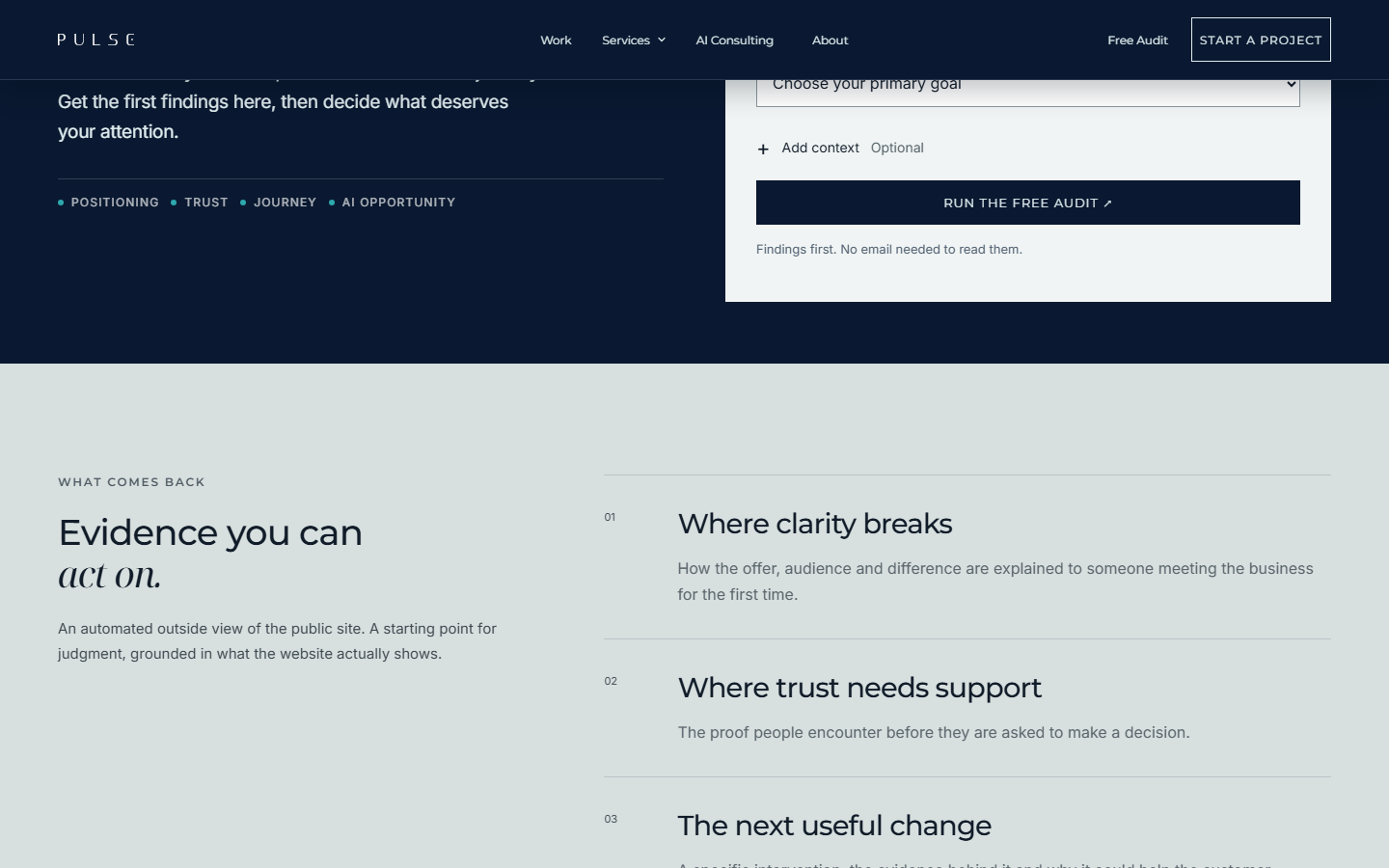
Reads the public site and reports what it finds, without being told.
Context · public site and service model
Tool access · read only
Memory · none beyond the session
Escalation · a person, on request
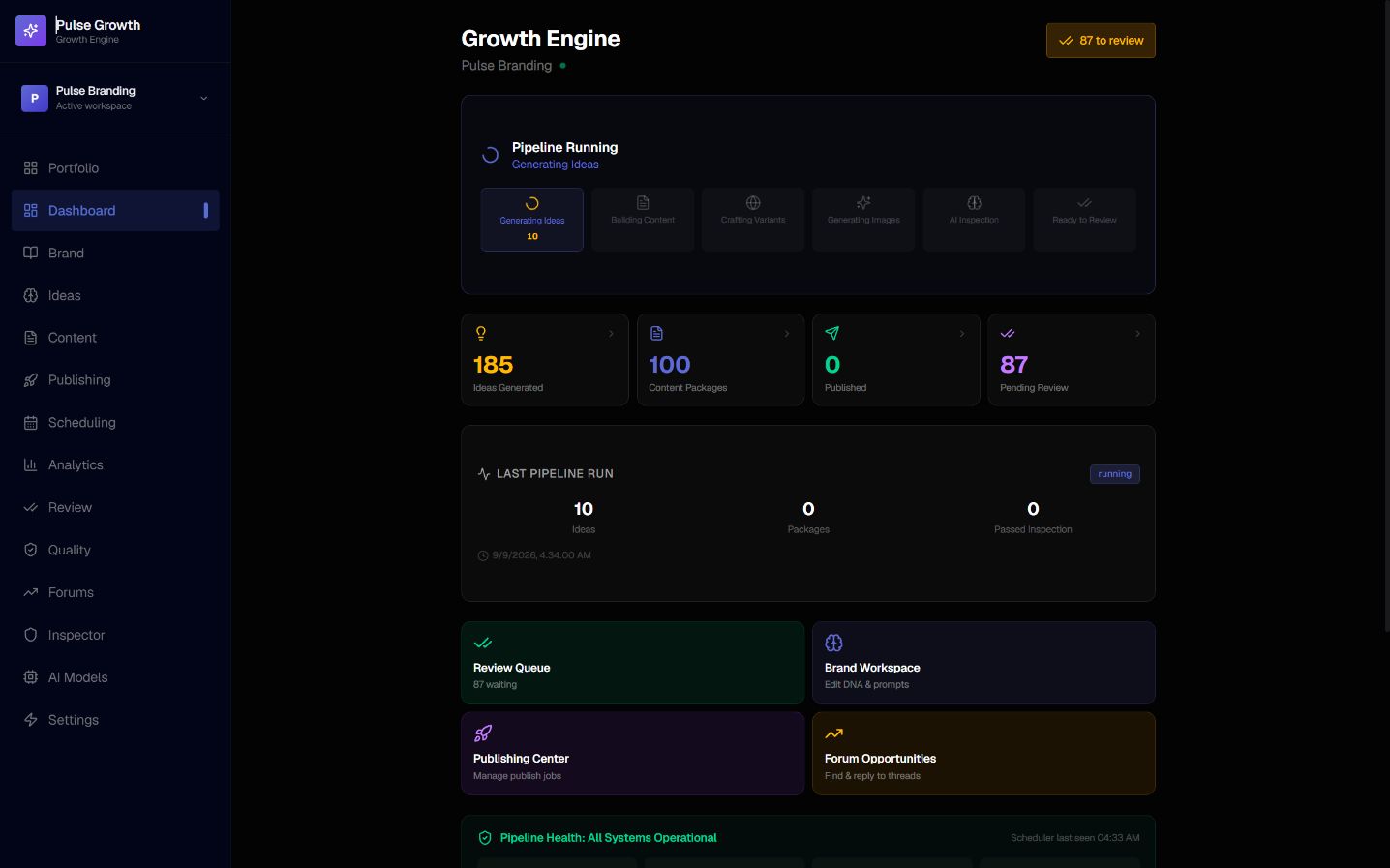
Turns the decisions into ongoing work someone actually owns.
Can machines understand what your company means?
“Build for attention. Design for trust. Optimize for choice.”
A human weighs the sentence, the work around it and the reputation behind it.
Being indexed is not enough. AI assistants increasingly interpret a business through its published language, evidence and structure. We examine whether a site is legible to people, search systems and AI without flattening the distinctions that make the business worth choosing.
Tell us what should happen. We will work out whether AI belongs there.
We map the task, the information it requires, the actions involved and where human judgment should remain. If AI is the wrong instrument, we say so.